For restaurants, being visible online can make the difference between a busy dining room and empty tables. When customers search for “restaurants near me,” “best restaurants near me,” “Italian restaurants near me,” “Indian restaurants near me,” or a specific dish, they are often ready to make a decision quickly.
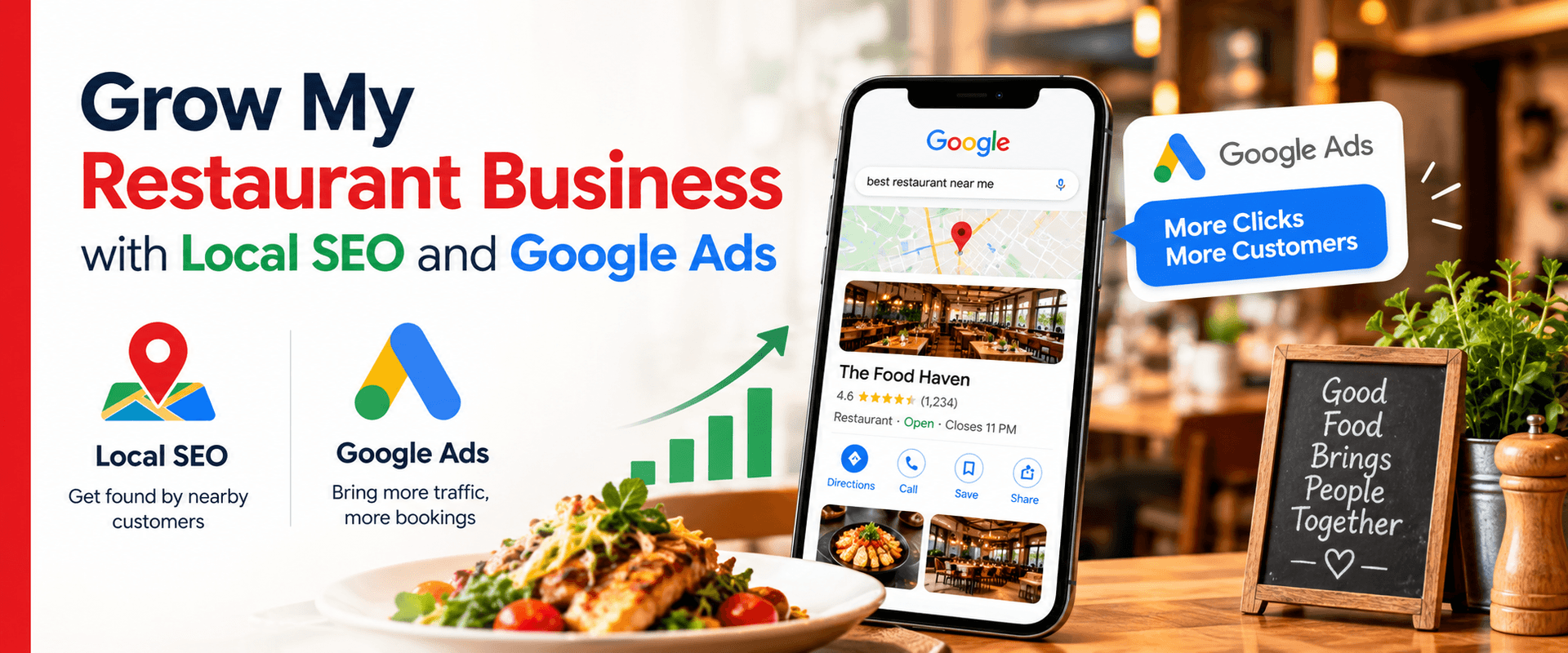
That is why local SEO and Google Ads for restaurants are two of the most effective digital marketing strategies for attracting nearby customers. Local SEO helps your restaurant appear organically in Google Search and Google Maps, while Google Ads can put your business in front of high-intent customers almost immediately.
When these strategies work together, your restaurant can increase local visibility, generate more calls, website visits, reservations, direction requests, and ultimately more customers.
Why Local SEO Matters for Restaurants
Restaurant searches are highly local. People generally do not want to travel across an entire city for an ordinary meal. They search for restaurants close to their home, workplace, hotel, or current location.
This makes local SEO for restaurants especially valuable.
When someone searches for a restaurant, Google may display a local map pack featuring nearby businesses. Your Google Business Profile, reviews, website, location, menu, photos, and overall online reputation can influence whether customers notice your restaurant.
A strong local SEO strategy helps your restaurant appear for searches such as:
- Restaurants near me
- Best restaurants in [city]
- Restaurants in [neighbourhood]
- Best [cuisine] restaurant near me
- Family restaurants near me
- Restaurants open now
- Takeout restaurants near me
- Restaurants for dinner
- Restaurants for lunch
- Best places to eat in [city]
The goal is not simply to generate website traffic. It is to attract local customers who are actively looking for somewhere to eat.
Optimize Your Google Business Profile
One of the most important parts of restaurant local SEO is your Google Business Profile.
Your profile is often the first impression potential customers have of your restaurant. Before visiting your website, they may look at your rating, photos, menu, opening hours, location, reviews, and other information displayed in Google Search and Maps.
Make sure your profile includes accurate and complete information.
Your restaurant should have:
- Correct business name and address
- Accurate opening and closing hours
- Phone number
- Website URL
- Updated menu
- High-quality food and restaurant photos
- Correct business category
- Relevant services and attributes
- Regular updates where appropriate
Incorrect hours can be particularly damaging. If customers arrive expecting your restaurant to be open and find it closed, you can lose both that customer and future business.
Keeping your Google Business Profile updated is one of the simplest ways to improve the customer experience and strengthen your local search presence.
Reviews Can Influence Restaurant Decisions
Online reviews are extremely important in the restaurant industry.
Before trying a new restaurant, customers commonly check the star rating and read reviews to understand the quality of the food, service, atmosphere, cleanliness, and overall experience.
Encourage satisfied customers to leave genuine Google reviews after their visit. Make the process simple by providing a direct review link or asking customers at an appropriate point after their experience.
However, the goal should never be to create fake reviews or manipulate ratings. Authentic customer feedback is far more valuable for building long-term trust.
Respond to both positive and negative reviews professionally. A thoughtful response shows potential customers that your restaurant listens and cares about customer experience.
Create Local Content That Customers Actually Search For
Your restaurant website should make it easy for Google and customers to understand where you are located and what you offer.
Instead of creating generic content that could apply to any restaurant, develop useful location-specific pages and content.
For example, a restaurant might target phrases such as:
“Best Italian restaurant in Vancouver”
“Family restaurant in Calgary”
“Indian restaurant in Mississauga”
“Best brunch restaurant in Ottawa”
“Restaurants near downtown Vancouver”
The exact keywords should depend on your restaurant, cuisine, location, and customer demand.
You can also create useful content around local dining searches, such as restaurant guides, special occasions, seasonal menus, neighbourhood dining, and food-related questions.
The key is to write for real customers first while naturally incorporating relevant local search terms.
Make Your Restaurant Website Mobile-Friendly
Restaurant customers frequently search from smartphones. They may be walking around a neighbourhood, driving to a destination, or deciding where to eat with friends and family.
Your website therefore needs to work extremely well on mobile devices.
Customers should be able to quickly find:
- Your menu
- Restaurant location
- Opening hours
- Phone number
- Reservation options
- Online ordering
- Directions
- Contact information
A slow, confusing, or difficult-to-use website can cause potential customers to leave and choose a competitor instead.
A mobile-friendly restaurant website should load quickly, have clear navigation, use readable text, and make important actions easy to find.
Where Google Ads Can Help
Local SEO is a long-term strategy. While it can generate valuable organic visibility, improving rankings takes time.
This is where Google Ads for restaurants can provide an immediate advantage.
Google Ads allows restaurants to advertise when potential customers search for relevant terms. Depending on your goals, campaigns can target people searching for specific cuisines, dining experiences, locations, or restaurant services.
For example, you might target searches related to:
- Best restaurant in [city]
- [Cuisine] restaurant near me
- Dinner restaurant in [neighbourhood]
- Family restaurant near me
- Restaurant reservations
- Best brunch in [city]
Instead of advertising to everyone, you can focus your budget on people who are more likely to become customers.
Use Location Targeting to Reach Nearby Customers
Restaurants do not need to advertise to an entire country or even an entire province.
For many restaurants, advertising within a carefully selected geographic area makes much more sense.
Google Ads location targeting can help you focus campaigns around the areas your restaurant actually serves. You can consider your neighbourhood, nearby communities, business districts, tourist areas, or other locations where your ideal customers are located.
This can help reduce wasted advertising spend and make your campaigns more relevant.
Your advertising strategy should also consider when people are most likely to search for restaurants. Depending on your business, this could include breakfast, lunch, dinner, weekends, holidays, or special events.
Local SEO and Google Ads Work Better Together
The biggest opportunity is not choosing between SEO and Google Ads. It is using both strategically.
Local SEO builds long-term visibility.
Google Ads provides immediate visibility.
SEO can help your restaurant generate organic traffic and local search exposure over time, while paid campaigns can provide additional visibility for high-value searches.
The data from Google Ads can also help identify which search terms generate clicks, calls, reservations, or other valuable actions. Those insights can inform your broader SEO and content strategy.
At the same time, strong organic visibility can reduce your dependence on paid advertising over the long term.
Together, these strategies can create a stronger and more consistent local customer acquisition system.
Don’t Depend Entirely on Delivery Apps
Food delivery platforms can help restaurants reach customers, but relying exclusively on third-party platforms can make customer acquisition expensive and limit your control over the customer relationship.
Your own website, Google Business Profile, local SEO strategy, Google Ads campaigns, email marketing, and social media presence can help create additional channels for attracting customers.
The objective is to build a digital presence that belongs to your restaurant rather than depending entirely on another platform for visibility.
Track What Actually Generates Customers
Digital marketing should be measurable.
Instead of focusing only on impressions or clicks, restaurant marketing should track actions that can contribute to revenue.
Important metrics can include:
- Phone calls
- Website visits
- Direction requests
- Reservation requests
- Online orders
- Menu views
- Google Business Profile interactions
- Ad conversions
- Cost per lead or customer
- Search visibility
Tracking these results allows you to understand what is working and where your marketing budget should be focused.
Start Growing Your Restaurant Online
If your restaurant is not appearing prominently when local customers search for places to eat, there is an opportunity to improve your online visibility.
Start with the basics: optimize your Google Business Profile, update your restaurant photos and menu, maintain accurate business information, encourage genuine customer reviews, improve your mobile website, and build location-focused content.
Then use Google Ads for restaurants to reach high-intent customers while your organic local SEO presence develops.
At Bernum, a digital marketing agency in Canada help businesses build practical digital marketing strategies designed to improve visibility, attract qualified local customers, and generate measurable growth.
For restaurants, the opportunity is simple: be visible when hungry customers are searching, give them a reason to choose you, and make it easy for them to take the next step.