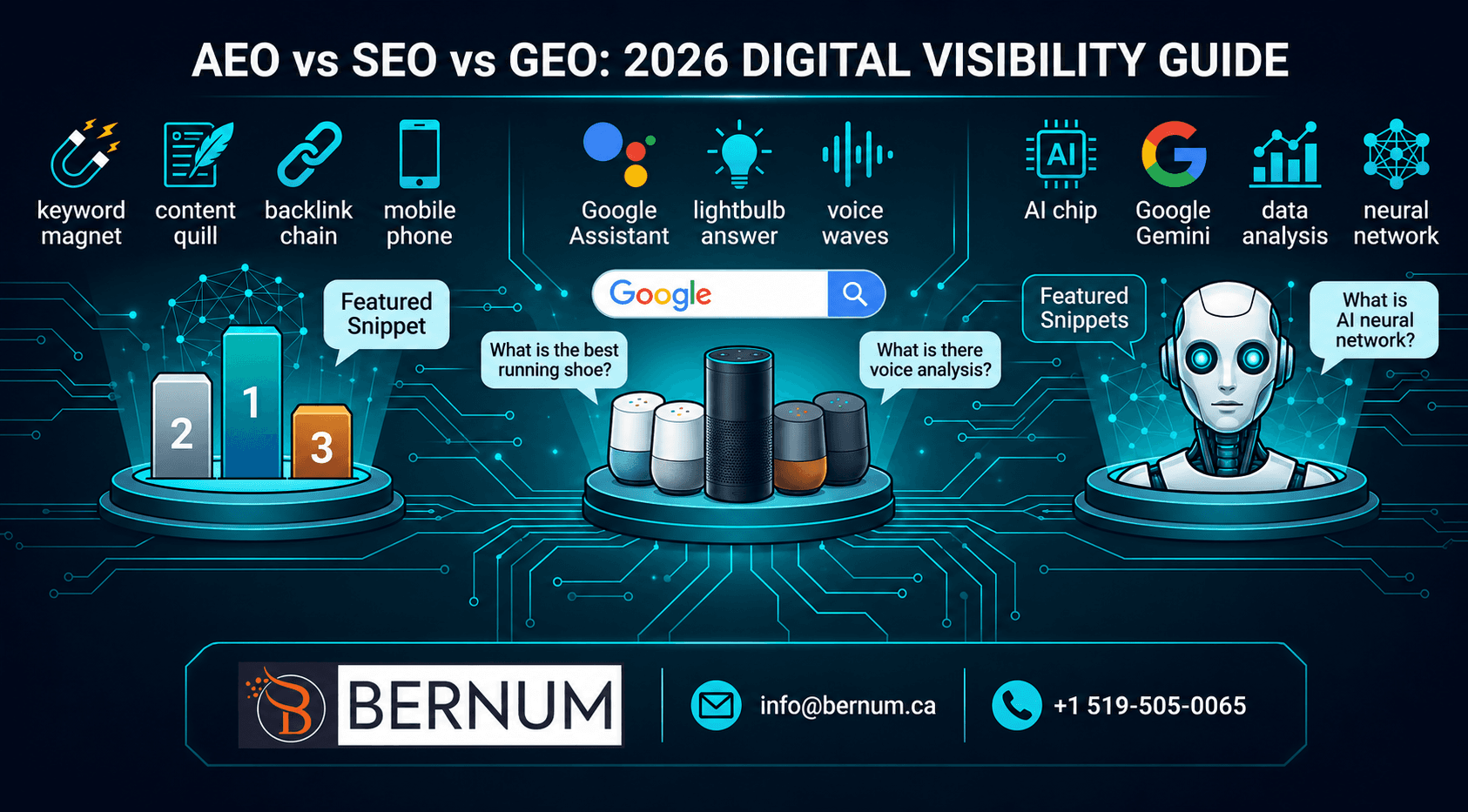
The digital marketing landscape is changing rapidly in 2026. Businesses are no longer competing only for rankings on Google — they are now competing for visibility inside AI-generated answers, voice search results, and conversational search platforms.
As artificial intelligence continues transforming the way people search online, three important optimization strategies are becoming essential:
- SEO (Search Engine Optimization)
- AEO (Answer Engine Optimization)
- GEO (Generative Engine Optimization)
While these terms are often used together, they serve very different purposes in modern digital marketing.
Understanding the differences between AEO, SEO, and GEO can help businesses improve online visibility, attract better traffic, and future-proof their marketing strategy in an increasingly AI-driven world.
In this guide, we’ll break down what each strategy means, how they differ, and what actually works in 2026.
What Is SEO?
SEO, or Search Engine Optimization, is the process of improving a website’s visibility in traditional search engine results.
The main goal of SEO is to help websites rank higher on platforms like Google and Bing when users search for products, services, or information.
Traditional SEO focuses on several core areas, including:
- Keyword optimization
- High-quality content creation
- Technical website performance
- Backlink building
- Mobile responsiveness
- Internal linking
- Site speed
- User experience
For many years, SEO has been the foundation of digital marketing because organic search traffic remains one of the most valuable lead sources for businesses.
However, SEO in 2026 looks very different from old-school keyword stuffing strategies.
Modern search engines now rely heavily on AI and machine learning to understand:
- Search intent
- Context
- User behavior
- Content quality
- Topical authority
This means websites can no longer rank well simply by repeating keywords. Search engines now prioritize genuinely useful, trustworthy, and well-structured content.
Businesses that create authoritative content designed around user needs tend to perform far better than those relying on outdated SEO tactics.
What Is AEO?
AEO stands for Answer Engine Optimization.
AEO focuses on optimizing content so it can appear as direct answers in search engines, voice assistants, and AI-powered answer systems.
Instead of users clicking through multiple websites, modern search platforms increasingly provide instant answers directly inside search results.
Examples of AEO include:
- Google Featured Snippets
- Voice search responses
- Siri answers
- Alexa results
- Google Assistant responses
- AI-generated summaries
For example, instead of typing:
“Best SEO strategies for local businesses”
Users may ask:
“What are the best SEO strategies for local businesses in 2026?”
Search engines and AI systems then try to provide a direct answer immediately.
This changes how businesses must structure their content.
To succeed with AEO, websites need content that is:
- Clear
- Concise
- Well-structured
- Question-focused
- Easy for AI systems to extract
Successful AEO strategies include:
- Using FAQ sections
- Writing conversational content
- Creating question-based headings
- Adding schema markup
- Providing short direct answers
- Structuring content logically
Voice search growth is one of the main reasons AEO is becoming increasingly important.
As more users rely on smartphones, smart speakers, and AI assistants, businesses must optimize for answers — not just rankings.
What Is GEO?
GEO stands for Generative Engine Optimization.
This is one of the newest digital marketing agency that share strategies emerging in 2026.
GEO focuses on optimizing content for AI-powered generative search engines and conversational AI platforms such as:
- ChatGPT
- Google Gemini
- Claude
- Perplexity AI
- Microsoft Copilot
Unlike traditional search engines, generative AI systems do not simply display a list of websites.
Instead, they generate summarized responses using information gathered from multiple online sources.
This fundamentally changes how users discover brands online.
For example, a user may ask:
“What are the best AI marketing agencies in Canada for SEO and automation?”
Instead of showing ten blue links, generative AI systems may provide a summarized recommendation list directly inside the response.
That means businesses now need content optimized not only for search engines but also for AI systems that interpret, summarize, and recommend information.
GEO focuses on helping AI systems:
- Understand your expertise
- Trust your content
- Recognize your authority
- Reference your brand accurately
- Include your business in AI-generated answers
This is why GEO is becoming a major focus for forward-thinking businesses in 2026.
Why GEO Is Becoming So Important in 2026
Generative AI search is growing incredibly fast.
Millions of users now use AI assistants to:
- Research products
- Compare services
- Find recommendations
- Learn new topics
- Make purchasing decisions
This shift means businesses relying only on traditional SEO could lose visibility over time.
GEO helps businesses stay visible inside AI-powered search experiences.
Benefits of GEO include:
- Increased AI visibility
- Stronger digital authority
- Better brand recognition
- More trust signals
- Future-proof marketing strategies
As AI-generated search becomes more mainstream, GEO will likely become one of the most important areas of digital marketing.
What Actually Works in 2026?
Many businesses chase algorithm updates and trendy marketing hacks.
But the truth is that successful digital marketing in 2026 relies on combining SEO, AEO, and GEO into one unified strategy.
Here’s what actually works:
1. High-Quality Content
Thin, low-value content no longer performs well.
Businesses must create useful, in-depth, trustworthy content that solves real user problems.
AI systems reward expertise and relevance.
2. Search Intent Optimization
Modern search engines prioritize intent over exact keywords.
Content should focus on what users actually want to know rather than simply targeting phrases.
3. Structured Formatting
Well-organized content is easier for both search engines and AI systems to understand.
This includes:
- Clear headings
- FAQs
- Bullet points
- Tables
- Short paragraphs
- Schema markup
4. Authority Building
Brands with strong authority are more likely to rank, appear in featured snippets, and get referenced by AI systems.
Authority comes from:
- Consistent publishing
- Expert-level content
- Backlinks
- Industry credibility
5. AI-Friendly Content Strategy
AI platforms prefer content that is:
- Accurate
- Context-rich
- Easy to understand
- Updated regularly
- Supported by expertise
This is why businesses must create content designed for both humans and AI systems.
Final Thoughts
The future of digital marketing is no longer just about SEO.
As AI reshapes online search behavior, businesses must adapt to new visibility opportunities created by answer engines and generative AI platforms.
SEO helps users find your website.
AEO helps your content become the answer.
GEO helps AI systems recommend your brand.
Together, these strategies create a powerful framework for long-term digital growth in 2026 and beyond.
Businesses that invest early in SEO, AEO, and GEO will gain a significant competitive advantage as AI-powered search continues transforming the internet. Try Bernum digital marketing agency now.